 Countertop Harvest
By the Countertop Harvest team · Last updated · How we choose products
Many kitchen herbs are on the ASPCA's non-toxic list for cats and dogs, and a few common ones are listed as toxic. We checked 18 plants from our growing guides against the ASPCA's toxic and non-toxic plant list and put the results on one printable page, with a line each on light and watering. Basil, rosemary, thyme and sage are on the non-toxic list, while mint, parsley, oregano and chives are listed as toxic.
Download the PDF (letter size) Download the PNG
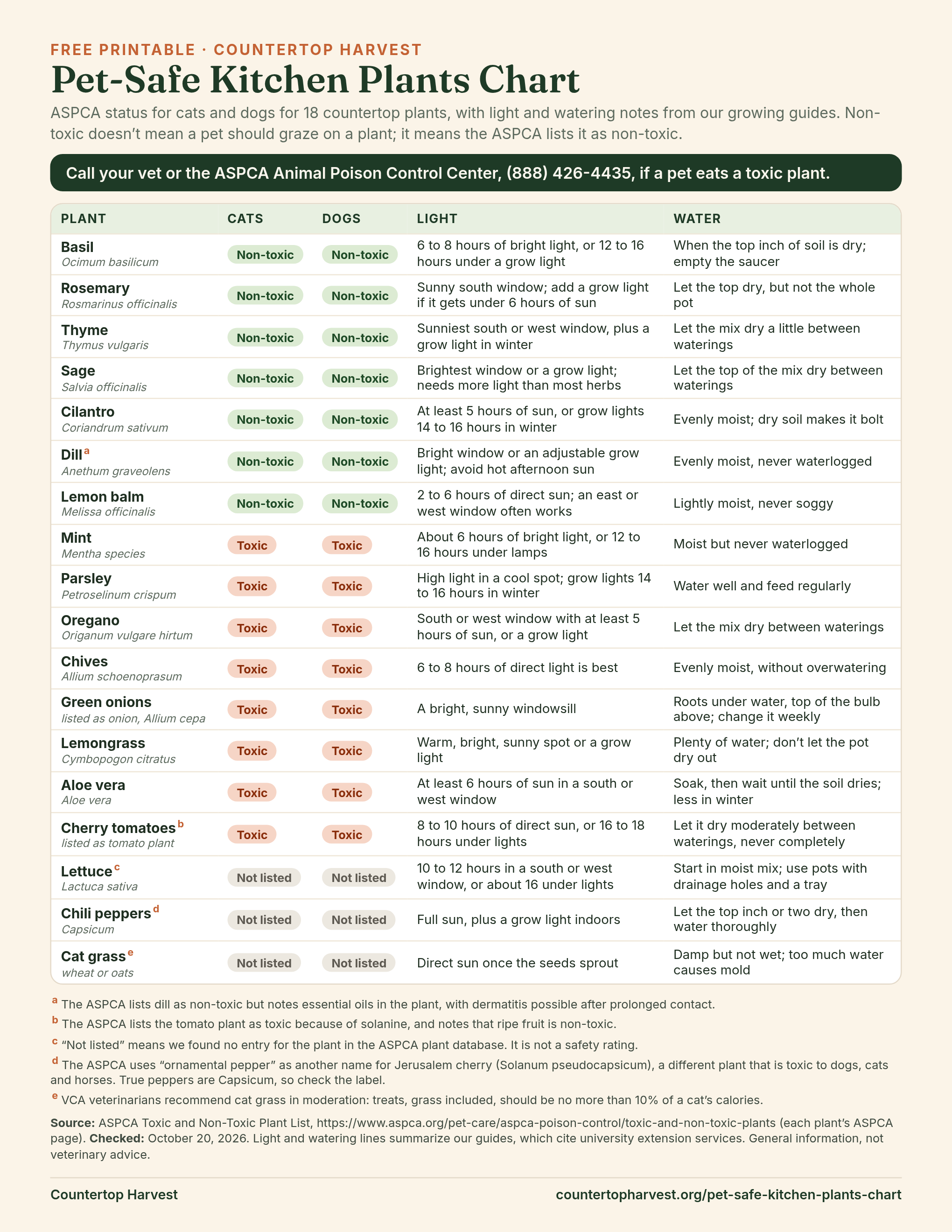
Free, with no signup. Print it for the fridge or save it to your phone.
The chart
Status for cats and dogs is copied from each plant's ASPCA page, linked in the last column. Light and water lines are short summaries of our guides; tap a plant name for the full guide and its sources.
| Plant | Cats | Dogs | Light | Water | Source |
|---|---|---|---|---|---|
| BasilOcimum basilicum | Non-toxic | Non-toxic | 6 to 8 hours of bright light, or 12 to 16 hours under a grow light. | When the top inch of soil is dry; empty the saucer. | ASPCA |
| RosemaryRosmarinus officinalis | Non-toxic | Non-toxic | Sunny south window; add a grow light if it gets under 6 hours of sun. | Let the top dry, but not the whole pot. | ASPCA |
| ThymeThymus vulgaris | Non-toxic | Non-toxic | Sunniest south or west window, plus a grow light in winter. | Let the mix dry a little between waterings. | ASPCA |
| SageSalvia officinalis | Non-toxic | Non-toxic | Brightest window or a grow light; needs more light than most herbs. | Let the top of the mix dry between waterings. | ASPCA |
| CilantroCoriandrum sativum | Non-toxic | Non-toxic | At least 5 hours of sun, or grow lights 14 to 16 hours in winter. | Evenly moist; dry soil makes it bolt. | ASPCA |
| DillaAnethum graveolens | Non-toxic | Non-toxic | Bright window or an adjustable grow light; avoid hot afternoon sun. | Evenly moist, never waterlogged. | ASPCA |
| Lemon balmMelissa officinalis | Non-toxic | Non-toxic | 2 to 6 hours of direct sun; an east or west window often works. | Lightly moist, never soggy. | ASPCA |
| MintMentha species | Toxic | Toxic | About 6 hours of bright light, or 12 to 16 hours under lamps. | Moist but never waterlogged. | ASPCA |
| ParsleyPetroselinum crispum | Toxic | Toxic | High light in a cool spot; grow lights 14 to 16 hours in winter. | Water well and feed regularly. | ASPCA |
| OreganoOriganum vulgare hirtum | Toxic | Toxic | South or west window with at least 5 hours of sun, or a grow light. | Let the mix dry between waterings. | ASPCA |
| ChivesAllium schoenoprasum | Toxic | Toxic | 6 to 8 hours of direct light is best. | Evenly moist, without overwatering. | ASPCA |
| Green onionslisted as onion, Allium cepa | Toxic | Toxic | A bright, sunny windowsill. | Roots under water, top of the bulb above; change it weekly. | ASPCA |
| LemongrassCymbopogon citratus | Toxic | Toxic | Warm, bright, sunny spot or a grow light. | Plenty of water; don’t let the pot dry out. | ASPCA |
| Aloe veraAloe vera | Toxic | Toxic | At least 6 hours of sun in a south or west window. | Soak, then wait until the soil dries; less in winter. | ASPCA |
| Cherry tomatoesblisted as tomato plant | Toxic | Toxic | 8 to 10 hours of direct sun, or 16 to 18 hours under lights. | Let it dry moderately between waterings, never completely. | ASPCA |
| LettucecLactuca sativa | Not listed | Not listed | 10 to 12 hours in a south or west window, or about 16 under lights. | Start in moist mix; use pots with drainage holes and a tray. | No entry |
| Chili peppersdCapsicum | Not listed | Not listed | Full sun, plus a grow light indoors. | Let the top inch or two dry, then water thoroughly. | No entry |
| Cat grassewheat or oats | Not listed | Not listed | Direct sun once the seeds sprout. | Damp but not wet; too much water causes mold. | No entry |
- a The ASPCA lists dill as non-toxic but notes essential oils in the plant, with dermatitis possible after prolonged contact.
- b The ASPCA lists the tomato plant as toxic because of solanine, and notes that ripe fruit is non-toxic.
- c “Not listed” means we found no entry for the plant in the ASPCA plant database. It is not a safety rating.
- d The ASPCA uses “ornamental pepper” as another name for Jerusalem cherry (Solanum pseudocapsicum), a different plant that is toxic to dogs, cats and horses. True peppers are Capsicum, so check the label.
- e VCA veterinarians recommend cat grass in moderation: treats, grass included, should be no more than 10% of a cat’s calories.
How we checked
On October 20, 2026 we opened the ASPCA Animal Poison Control Center's page for each plant and copied its listing for dogs and cats exactly. Where we found no ASPCA entry, the chart says "Not listed" rather than guessing. Non-toxic doesn't mean a pet should graze on a plant, so we still keep our pots where a curious cat can't make a meal of them. For cat grass, which the ASPCA doesn't list, we used the moderation advice from VCA Animal Hospitals.
If you think a pet has eaten a plant on the toxic list, the ASPCA asks you to call its Animal Poison Control Center at (888) 426-4435 or your veterinarian; a consultation fee may apply.
Growing guides for every plant on the chart
We have a full guide for each plant on the chart: basil, rosemary, thyme, sage, cilantro, dill, lemon balm, mint, parsley, oregano, chives, green onions, lemongrass, aloe vera, cherry tomatoes, lettuce, chili peppers and cat grass. You can also find a guide by plant.
Sources
- ASPCA Animal Poison Control Center: Toxic and non-toxic plants list
- ASPCA: Basil
- ASPCA: Rosemary
- ASPCA: Thyme
- ASPCA: Sage
- ASPCA: Cilantro
- ASPCA: Dill
- ASPCA: Lemon balm
- ASPCA: Mint
- ASPCA: Parsley
- ASPCA: Oregano
- ASPCA: Chives
- ASPCA: Onion
- ASPCA: Lemongrass
- ASPCA: Aloe vera
- ASPCA: Tomato plant
- ASPCA: Jerusalem cherry (also called ornamental pepper)
- VCA Animal Hospitals: Where the green grass grows, grass treats for cats
All sources accessed October 20, 2026. This chart is general information and is not veterinary advice.
Frequently asked questions
Which kitchen herbs are safe for cats and dogs?
On the ASPCA plant list, basil, rosemary, thyme, sage, cilantro, dill and lemon balm are non-toxic to dogs and cats.
Which kitchen plants are toxic to pets?
The ASPCA lists mint, parsley, oregano, chives, onion, lemon grass, aloe and the tomato plant as toxic to dogs and cats. It notes that ripe tomato fruit is non-toxic.
What should I do if my pet eats a toxic plant?
Call your vet or the ASPCA Animal Poison Control Center, (888) 426-4435, if a pet eats a toxic plant.